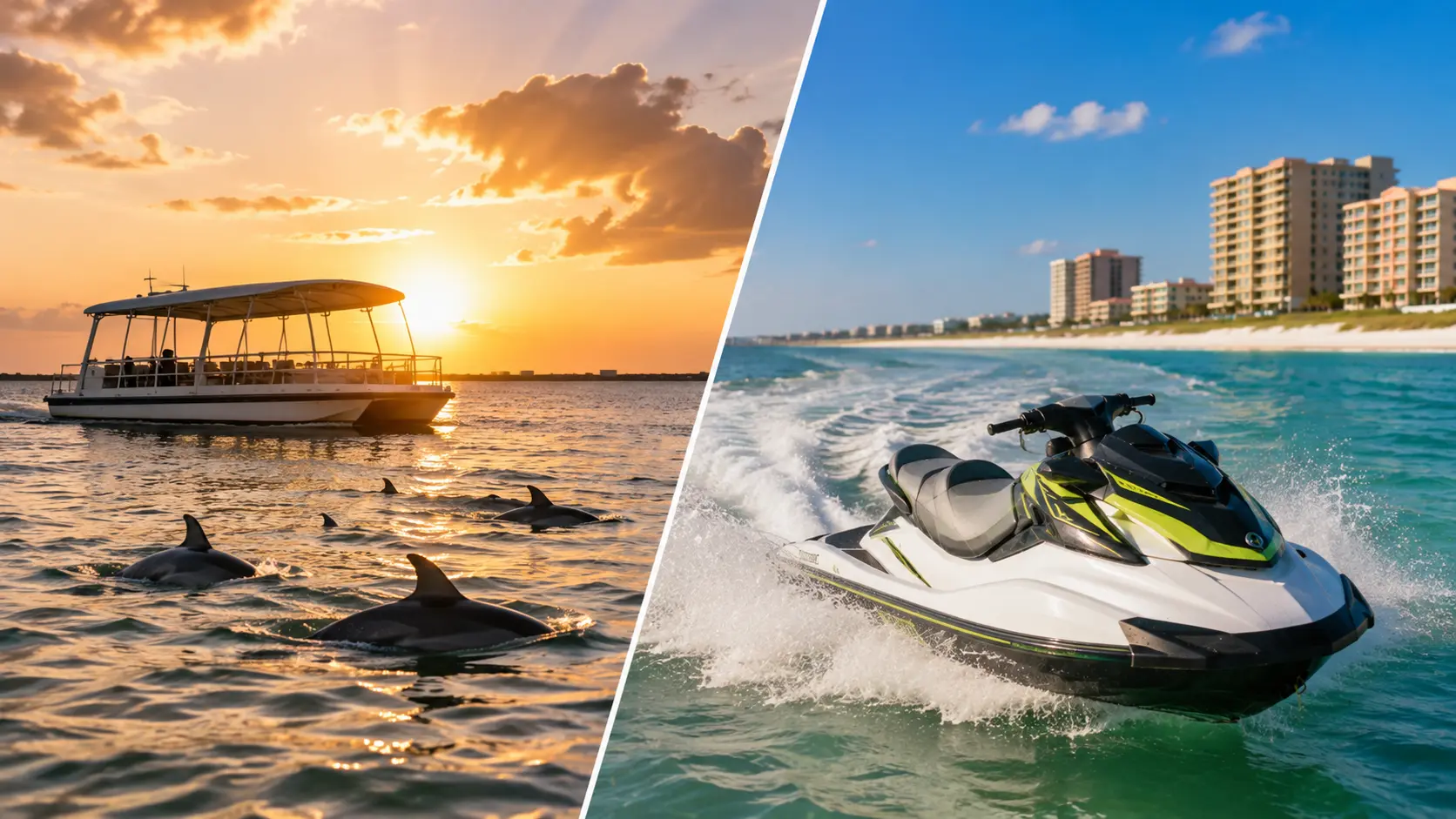
Why Preventative Powersports Maintenance Saves You Money
Powersports equipment that sits idle between seasons doesn’t stay neutral. It degrades. Every week without attention is a slow accumulation of corrosion, fluid breakdown, and mechanical stress that compounds quietly until the moment you need the machine most.
Direct Answer
Preventative powersports maintenance saves money by catching small, inexpensive problems before they escalate into major mechanical failures. Regular oil changes, inspections, and seasonal servicing typically cost a fraction of what emergency repairs or component replacements demand. Operators who follow structured maintenance schedules consistently report longer vehicle lifespans and fewer unexpected breakdowns.
Key Takeaways
- Routine maintenance costs are significantly lower than the average cost of a single major mechanical repair
- Regular inspections catch corrosion, fluid degradation, and wear before they cause component failure
- Seasonal maintenance, especially winterization and spring recommissioning, is the highest-leverage maintenance window
- Professional service support identifies problems that visual inspections miss entirely
- Skipping maintenance doesn’t save money; it defers costs while adding interest in the form of compounding damage
What Is the Real Cost of Skipping Maintenance?
Most powersports owners think about maintenance as an expense. It is not. It is a hedge against a much larger, unpredictable expense arriving at the worst possible time.
Consider a practical scenario: a jet ski that misses two consecutive seasonal services develops a corroded impeller and a degraded wear ring. Left unaddressed, the wear ring failure accelerates stress on the pump housing. A repair that would have cost roughly $80 at first detection becomes a $600 – $900 pump assembly replacement. Plus labor, plus downtime during peak season.
The mechanism here is not just neglect. It is compounding mechanical debt. Each skipped service allows minor wear to accelerate adjacent components. The impeller doesn’t just fail; it takes the pump housing with it. This is why the cost curve on deferred maintenance is not linear. It bends upward sharply.
Practitioners in the powersports service industry consistently report that the majority of major repair jobs they see were preventable. And that most originated from a single missed inspection cycle.
Why Do Owners Keep Skipping Maintenance Even When They Know Better?
The root cause is not laziness. It is misaligned timing.
Powersports vehicles are used intensely in short bursts. A summer season, a vacation week, a holiday weekend. The maintenance window that matters most (the period immediately before and after heavy use) is also the period when owners are least focused on logistics. They’re planning the trip, not scheduling the service.
This creates a structural gap: the machine gets used hard, stored quickly, and inspected never. By the time the next season arrives, months of corrosion and fluid breakdown have already done their work.
The second driver is invisible damage. A jet ski that starts and runs doesn’t signal distress until it fails. Unlike a car with a dashboard warning light, most powersports vehicles give no early warning system. The damage accumulates silently, which means owners receive no behavioral feedback that would prompt action.
Maintenance that isn’t visible doesn’t feel urgent. Until the repair bill makes it very visible.
The Maintenance-vs-Repair Cost Comparison: What the Numbers Actually Show
Here is where the math becomes impossible to ignore.
| Maintenance Activity | Typical Preventative Cost | Repair Cost If Skipped |
| Annual oil and filter change | $40 – $80 | Seized engine: $1,500 – $4,000+ |
| Impeller and wear ring inspection | $50 – $100 | Pump assembly replacement: $600 – $900 |
| Cooling system flush | $60 – $120 | Overheating damage / head gasket: $800 – $2,500 |
| Battery maintenance / storage prep | $20 – $50 | Battery replacement + electrical diagnosis: $200 – $500 |
| Fuel system stabilization (seasonal) | $15 – $30 | Carburetor rebuild or fuel injector service: $300 – $700 |
The pattern is consistent across every line item: preventative costs are measured in tens of dollars. Repair costs from the same neglected issue are measured in hundreds or thousands.
Industry service data consistently shows that a structured annual maintenance program costs a fraction of what a single unplanned mechanical failure costs. Even in a low-failure year.
What Does a Seasonal Maintenance Strategy Actually Look Like?
Seasonal maintenance strategy is a structured, calendar-based approach that aligns service intervals with the natural use cycles of powersports equipment.
There are two critical windows: pre-season commissioning and post-season storage preparation. Both are equally important, and most owners only focus on one.
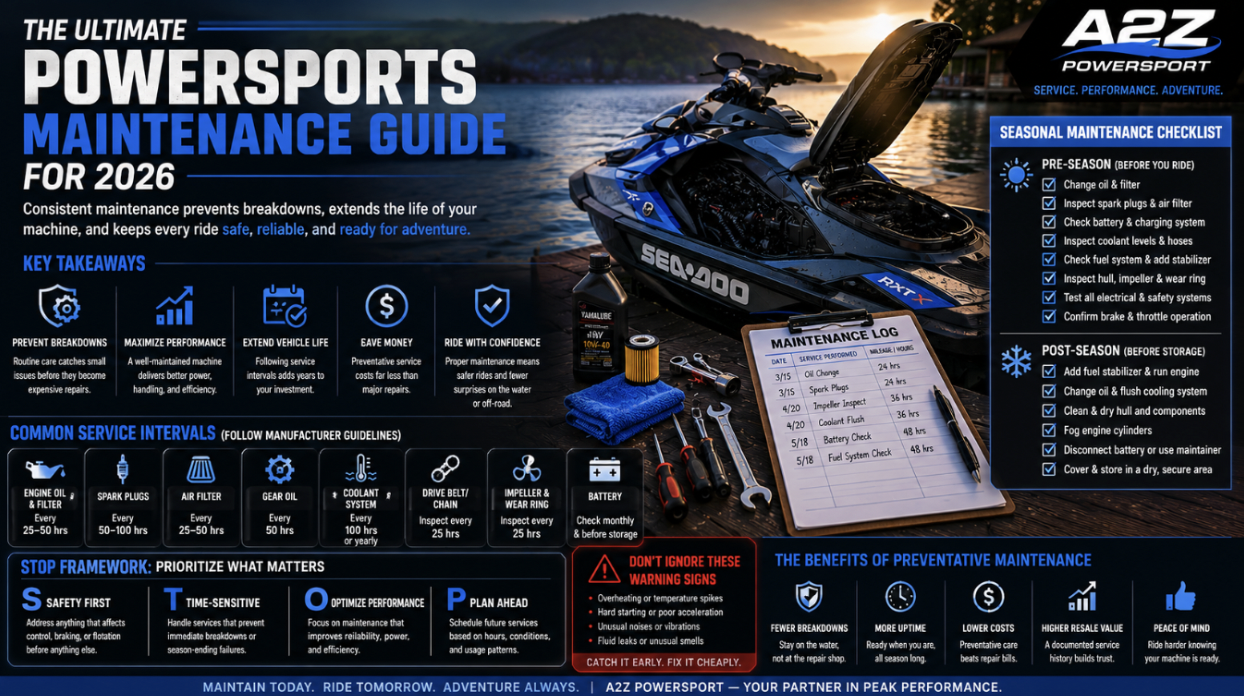
Pre-season commissioning (spring/early summer) should include: fresh engine oil and filter, spark plug inspection, battery load test, cooling system check, hull inspection for cracks or stress fractures, and a full operational test run before the first guest or rider ever touches the machine.
Post-season storage preparation (fall/winter) is where most damage originates from neglect. This window requires: fuel stabilizer treatment, fogging oil in the cylinders to prevent corrosion, flushing the cooling system with fresh water, battery tender connection or removal, and covering the hull to prevent UV degradation and moisture intrusion. Following essential tips for winterizing your jet ski during this window is one of the highest-leverage actions an owner can take.
A machine that goes into storage correctly comes out of storage correctly. One that doesn’t. Doesn’t.
At A2Z Powersport, seasonal servicing is built into the operational rhythm precisely because their fleet runs hard during Orange Beach’s peak season. Machines that skip post-season prep don’t just cost more to repair. They’re unavailable when guests arrive in June expecting a premium experience.
The Preventative Maintenance Priority Framework (The PMP Score)
The PMP Score is a simple triage tool for prioritizing which maintenance tasks to address first when time or budget is constrained.
Score each maintenance item on three dimensions (1-3 scale each):
- Failure Impact: How severe is the consequence if this component fails? (1 = cosmetic, 3 = machine inoperable or unsafe)
- Failure Likelihood: How likely is failure given current condition and usage? (1 = unlikely, 3 = overdue or showing early symptoms)
- Detection Difficulty: How hard is this failure to detect before it becomes major? (1 = obvious, 3 = invisible until catastrophic)
Use this when: You have multiple deferred maintenance items and limited service budget. Address the highest combined scores first.
Not when: You have a machine showing active symptoms. That requires immediate diagnosis, not triage scoring.
A cooling system flush on a machine that’s been running hot scores 3-3-3. A cosmetic hull scratch scores 1-1-1. The framework makes the prioritization explicit rather than intuitive.
What Professional Service Support Catches That You Can’t
Visual inspection by an owner catches surface-level issues. Professional service support catches the ones that aren’t visible.
A trained technician performing a diagnostic service will check torque specs on critical fasteners, measure impeller clearance tolerances, pressure-test the cooling system, inspect electrical connections for early corrosion, and evaluate fuel system integrity. None of which are accessible to a standard owner inspection.
The value of professional service is not labor. It is pattern recognition. A technician who has serviced hundreds of jet skis knows what a wear ring that has 40 hours of life left feels like versus one that has 5. That knowledge is not available in an owner’s manual.
A2Z Powersport’s service approach reflects this directly. Their team works with equipment daily, which means they recognize early failure signatures that a seasonal owner would never catch. Practitioners using this approach report catching two to four actionable issues per service visit that the owner was unaware of. Reviewing a comprehensive guide to jet ski maintenance can help owners understand what a thorough professional inspection actually covers.
This is also why the “I’ll just check it myself” approach has a ceiling. It works for fluid levels and visual hull checks. It doesn’t work for internal wear assessment
Who This Approach Is Not For
Preventative maintenance is not the right framing for equipment that is already showing active mechanical symptoms. If a machine is running rough, overheating, or producing unusual noise, that is a diagnostic situation. Not a maintenance situation. Applying a maintenance schedule to a machine in active distress delays the diagnosis it actually needs.
It also doesn’t eliminate all repair costs. Wear is inevitable. Components have finite lifespans regardless of care. The honest outcome of good maintenance is not zero repair bills. It is predictable, lower-cost repair bills on a known timeline rather than surprise failures at peak season.
And if a machine has been stored improperly for multiple seasons without any service, a standard maintenance visit may surface deferred damage that requires repair before maintenance can resume. That is not a failure of the maintenance approach. It is the cost of the gap.
FAQ
How often should I get my jet ski serviced?
Most manufacturers recommend annual service or service every 50 hours of operation, whichever comes first. For machines used heavily during a summer season, an annual pre-season service plus a post-season storage preparation visit covers the critical windows. Skipping either one creates compounding risk.
What happens if I store my jet ski without winterizing it?
Moisture left in the cooling system can cause corrosion and, in freezing temperatures, cracked components. Untreated fuel degrades and clogs fuel injectors or carburetors. A machine stored without proper preparation often requires several hundred dollars in corrective work before it’s safe to run the following season.
Is preventative maintenance worth it for a rental fleet specifically?
Yes. More so than for personal use. Rental fleet machines run more hours, carry more varied operators, and face more stress than personally owned equipment. A single breakdown during peak season means lost revenue, disappointed guests, and potential safety liability. The ROI on fleet maintenance is direct and measurable.
How do I know if my powersports equipment needs service right now?
If it’s been more than 12 months since the last service, or more than 50 hours of operation, it needs service regardless of how it feels. Machines that seem to run fine are often carrying deferred wear that isn’t detectable without a professional inspection.
Can I do powersports maintenance myself to save money?
Basic tasks, fluid top-offs, battery charging, visual hull checks, are owner-appropriate. Internal inspections, impeller clearance measurement, cooling system pressure tests, and torque verification require tools and pattern recognition that most owners don’t have. Attempting those without the right background often creates new problems while missing the original ones.
What’s the most expensive repair that regular maintenance prevents?
Engine seizure from oil starvation or overheating is consistently the highest-cost failure in the powersports category, often running $1,500 to $4,000 or more depending on the engine. It is also one of the most preventable. Regular oil changes and cooling system checks directly address its root causes.
Does A2Z Powersport offer maintenance services for personal watercraft?
A2Z Powersport provides professional service support for powersports equipment. Contacting them directly at (954) 296-1862 or visiting their location at 26619 Perdido Beach Blvd, Orange Beach, AL 36561 is the fastest way to get a current service assessment and schedule.
Preventative maintenance is not the cost of owning a powersports vehicle. It is the cost of owning one that works when you need it.
If you’re heading into peak season, or coming out of one, now is the right moment to schedule a professional service visit before the repair that was avoidable becomes the repair that isn’t. Book your maintenance service with A2Z Powersport today. Call (954) 296-1862 or stop by Zeke’s Landing and Marina on Perdido Beach Blvd. The machines that run reliably all season long are the ones that got serviced before the season started.
References
Bureau of Labor Statistics. General consumer cost and services pricing context.
A2Z Powersport. Operational service data and fleet maintenance practices, Orange Beach, Alabama.