The Ultimate Powersports Maintenance Guide for 2026
Most powersports vehicles don’t break down because owners ignored them. They break down because owners maintained them on the wrong schedule, using the wrong assumptions. The gap between “I take care of it” and “I take care of it correctly” is where most mechanical failures actually live.
A complete powersports maintenance guide covers five core disciplines: fluid and filter service on manufacturer-specified intervals, pre-season and post-season inspections, battery and fuel system care during storage, drivetrain and brake checks before high-demand riding, and a documented maintenance log that creates a traceable service history. Following these disciplines consistently prevents the majority of avoidable mechanical failures.
Key Takeaways
- Manufacturer service intervals are minimum thresholds, not optimal ones. High-use vehicles need more frequent attention
- Fuel degradation during storage is the single most common cause of spring startup failures in powersports equipment
- A documented maintenance log reduces diagnostic time and increases resale value by giving buyers verifiable proof of care
- Seasonal inspections should follow a fixed checklist, not memory. Memory skips the same items every time
- Brake and coolant systems are the two most under-inspected components in recreational powersports maintenance
Why Does Powersports Maintenance Feel More Complicated Than It Should?
The honest answer: because most owners treat their vehicles like cars, and powersports equipment doesn’t behave like cars.
Cars run year-round, accumulate mileage steadily, and get serviced by shops that see the same failure patterns weekly. Powersports vehicles, jet skis, ATVs, UTVs, dirt bikes, personal watercraft, often sit unused for months, get ridden hard in short bursts, and are stored in conditions that accelerate degradation faster than regular use does.
The maintenance problem isn’t neglect. It’s misapplied logic from a different vehicle category.
Practitioners who service powersports equipment consistently report that storage-related failures outnumber use-related failures. A jet ski ridden hard every weekend for a season is often in better mechanical condition than one stored improperly for eight months.
This reframes the entire maintenance conversation. The question isn’t just “what do I do after I ride?” It’s “what do I do when I’m not riding?”
What Does a Complete Powersports Maintenance Checklist Actually Include?
There are two layers to a complete checklist: the recurring service items and the condition-based items that only matter at specific intervals or events.
Recurring Service Items (every season or per manufacturer interval):
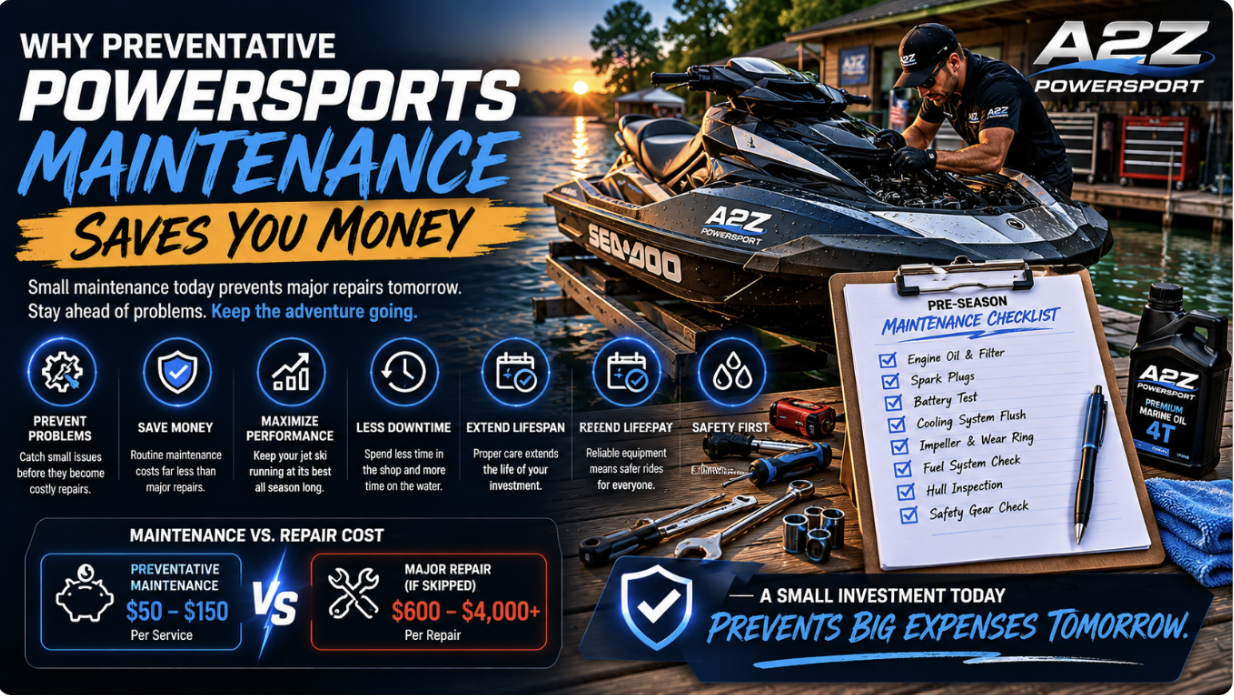
- Engine oil and filter replacement
- Air filter inspection and replacement
- Spark plug inspection (replace at manufacturer interval or if fouled)
- Coolant level check and flush per interval
- Brake fluid inspection and replacement
- Drive belt or chain inspection and tension adjustment
- Battery charge level and terminal corrosion check
- Fuel filter replacement
- Tire pressure and tread inspection (ATVs, UTVs, dirt bikes)
- Hull and impeller inspection (personal watercraft and jet skis)
Condition-Based Items (triggered by events, not just time):
- Full brake inspection after any high-impact ride or crash
- Impeller and wear ring inspection after riding in shallow or debris-heavy water
- Steering and suspension check after aggressive off-road use
- Fuel system inspection if vehicle sat with untreated fuel for more than 30 days
The distinction matters because condition-based items get skipped when owners only think in time-based intervals. A jet ski that hit a sandbar once needs an impeller check regardless of when the last scheduled service was.
What Are the Seasonal Inspection Steps That Most Owners Miss?
Seasonal preparation is where the most preventable failures originate. Industry service data consistently shows that spring startup failures, vehicles that won’t start or run rough after winter storage, are almost entirely attributable to three causes: degraded fuel, discharged or sulfated batteries, and dried or cracked seals.
The Pre-Season Inspection Sequence:
- Fuel system first. Drain or treat stale fuel before attempting startup. Ethanol-blended fuel begins to degrade in as little as 30 days. A vehicle stored without fuel stabilizer for a full winter almost certainly has varnish deposits in the carburetor or fuel injectors.
- Battery load test. A battery that holds voltage at rest but fails under load will strand you. Voltage alone doesn’t tell you capacity.
- Cooling system. Check coolant level, inspect hoses for cracking, and verify the thermostat is functioning before the first hard ride of the season.
- Brake system. Brake fluid is hygroscopic, meaning it absorbs moisture from the air over time. Fluid that sat all winter has a lower boiling point than fresh fluid, which matters when brakes work hard.
- Visual hull and drivetrain inspection. Look for anything that changed during storage: rodent damage, cracked components, loose connections.
The Post-Season Shutdown Sequence:
- Add fuel stabilizer and run the engine long enough to circulate it through the system
- Fog the engine cylinders with fogging oil if storing for more than 60 days
- Disconnect and trickle-charge the battery, or use a smart maintainer
- Flush the cooling system on personal watercraft with fresh water
- Cover and store in a dry, temperature-stable environment
Skipping the post-season sequence is what creates the pre-season problems. They’re the same event, separated by months. Owners looking for a structured approach to essential tips for winterizing your jet ski will find that the same principles apply across the full range of powersports equipment.
The STOP Framework: A Named Decision Tool for Maintenance Prioritization
The STOP Framework is a four-category maintenance triage system that helps powersports owners prioritize which issues require immediate action versus scheduled attention.
- S. Safety-Critical: Brakes, steering, throttle response. Any issue here stops riding immediately. No exceptions.
- T. Time-Sensitive: Fuel system, battery, coolant. These degrade on a timeline whether you ride or not. Address before storage and before first seasonal use.
- O. Operational: Oil, filters, belts, spark plugs. These follow manufacturer intervals and usage patterns.
- P. Preventive: Hull inspections, seal checks, cable lubrication. These extend lifespan and prevent future issues but aren’t urgent.
Use STOP when you’re looking at a list of deferred maintenance items and need to decide what to address first. Don’t use it as a reason to defer Safety-Critical items. That category has no flexibility.
What Are the Most Common Maintenance Mistakes That Shorten Vehicle Life?
Mistake 1: Using the owner’s manual interval as a ceiling, not a floor.
Manufacturer service intervals are written for average use under average conditions. A jet ski rented or ridden daily in saltwater is not average use. Practitioners servicing high-use rental fleets. Including operations like A2Z Powersport, which maintains a fleet of high-powered watercraft in Gulf saltwater conditions. Typically run oil and impeller checks at half the standard interval. Saltwater accelerates corrosion on every exposed metal component. The interval that works for a freshwater lake doesn’t apply here.
Mistake 2: Storing with a full fuel tank “to prevent moisture.”
This is a persistent myth. A full tank of untreated fuel degrades just as fast as a half-empty one. What prevents moisture is fuel stabilizer. Not fuel volume. Storing with a full tank of stabilized fuel is fine. Storing with a full tank of untreated fuel is a guaranteed carburetor cleaning job in the spring.
Mistake 3: Assuming a visual inspection is the same as a functional check.
A battery can look perfect and fail under load. A brake caliper can look clean and be sticking. Visual inspections catch obvious problems. Functional checks catch the ones that strand you. A guide to jet ski maintenance covering when and how to keep your ride smooth reinforces why functional checks, not just visual ones, are the standard that experienced operators follow.
How Does Documented Maintenance Compare to Memory-Based Maintenance
| Factor | Memory-Based Maintenance | Documented Maintenance Log |
| Service interval accuracy | Approximate, often overdue | Exact, traceable |
| Diagnostic speed when issues arise | Slow. No history to reference | Fast. Service history narrows causes |
| Resale value impact | Buyer has no proof of care | Verifiable history increases buyer confidence |
| Warranty and service claim support | Difficult to prove compliance | Documentation supports claims |
| Consistency across multiple vehicles | Nearly impossible | Standardized across fleet |
A documented log doesn’t just track what you did. It reveals patterns. A vehicle that consistently burns through oil between intervals has a problem that only shows up when you’re looking at the data across multiple service points, not just the most recent one.
A2Z Powersport maintains documented service records across its full rental fleet precisely because pattern recognition in maintenance data prevents the kind of mid-season mechanical failure that disrupts customer experiences on the water.
Who Is This Guide Not For?
This guide is built for owners and operators who ride seasonally, store their vehicles for extended periods, or manage more than one unit.
It is not a substitute for manufacturer-specific service manuals. Torque specifications, fluid capacities, and component replacement procedures vary significantly by make and model. Those details belong in the OEM documentation, not a general guide.
It also doesn’t apply to vehicles under active dealer warranty that require authorized service to maintain coverage. If your vehicle is under warranty, verify which maintenance tasks you can perform yourself without voiding it.
And if your vehicle has already been sitting for two or more seasons without any maintenance, this guide is a starting point. But a professional inspection before first use is the right call. Some storage damage isn’t visible and isn’t safe to ride through.
Frequently Asked Questions
How often should I actually change the oil in my jet ski or ATV?
Most manufacturers recommend oil changes every 50 hours of operation or once per season, whichever comes first. If you’re riding in saltwater, running at high RPM frequently, or using the vehicle commercially, practitioners recommend cutting that interval in half. Oil in high-stress conditions breaks down faster than the standard interval assumes.
What happens if I don’t use fuel stabilizer before storing my powersports vehicle?
Ethanol-blended fuel begins to degrade in as little as 30 days and can leave varnish deposits in carburetors and fuel injectors within a single off-season. This typically results in a no-start or rough-running condition in spring that requires carburetor cleaning or injector service. A repair that costs significantly more than a bottle of stabilizer.
Is it okay to pressure wash my jet ski or ATV after riding?
Yes, with specific caution. Pressure washing is appropriate for hull exteriors, frames, and undercarriages. It is not appropriate for electrical connections, air intake components, or bearing surfaces. Direct high-pressure water into those areas forces moisture into places it can’t easily escape, which accelerates corrosion and electrical failure.
How do I know if my battery needs to be replaced or just recharged?
A battery that charges fully but drops to low voltage within a day or two of sitting is sulfated and needs replacement. A smart battery maintainer can sometimes recover a mildly sulfated battery, but one that fails a load test, meaning it can’t deliver adequate current under demand, should be replaced before the season starts, not after it strands you.
What’s the most important thing to do before the first ride of the season?
Run through the fuel system first. Stale fuel is the leading cause of spring startup failures in stored powersports equipment. Drain or treat old fuel, check that the engine starts and runs cleanly, then move through brakes, cooling system, and battery before taking the vehicle out for a full ride.
Can I do powersports maintenance myself or do I need a professional?
Most recurring maintenance tasks. Oil changes, filter replacements, battery service, visual inspections. Are well within the capability of an attentive owner with basic tools and the OEM service manual. Tasks involving brake hydraulics, fuel system rebuilds, or electrical diagnosis are better handled by a qualified technician unless you have specific mechanical experience with those systems.
How does saltwater riding change the maintenance schedule?
Saltwater accelerates corrosion on every exposed metal surface and works into seals, bearings, and electrical connections faster than freshwater. Post-ride freshwater flushing is mandatory, not optional. Oil and impeller inspection intervals should be shortened. Corrosion inhibitor on electrical connections and exposed metal should be part of every post-season shutdown. Operators like A2Z Powersport, running watercraft daily in Gulf saltwater, treat saltwater maintenance as a fundamentally different discipline from freshwater maintenance. Because it is.
Maintenance done from memory is maintenance done inconsistently. And inconsistency is just deferred failure with better timing.
Download the Free Seasonal Maintenance Log
You’ve read the framework. Now put it to work.
The A2Z Powersport Seasonal Maintenance Log gives you a ready-to-use, printable checklist built around the pre-season, in-season, and post-season sequences in this guide. It includes service date tracking, interval reminders, and a notes column for condition-based observations. Everything you need to build a documented service history instead of relying on memory.
Download the free seasonal maintenance log today and start the 2026 season with a vehicle you can actually trust.
References
U.S. Consumer Product Safety Commission. Powersports vehicle incident and failure data
Outdoor Power Equipment Institute (OPEI). Fuel stability and ethanol-blend guidance for small engines and powersports equipment
Battery Council International. Battery maintenance, sulfation, and load testing standards
Equipment manufacturers’ OEM service documentation (Honda, Yamaha, Sea-Doo, Kawasaki, Polaris). Interval and specification benchmarks referenced qualitatively throughout