The Future of Smart Powersports Technology in 2026
Smart powersports technology is no longer a concept reserved for prototype labs or manufacturer R&D departments. It is arriving on the water right now. And the riders, rental operators, and service teams who understand what it actually does will have a significant advantage over those who are still reacting to breakdowns after they happen.
Key Takeaways
- Smart diagnostics can detect mechanical stress in powersports vehicles before a failure event occurs, reducing unplanned downtime by identifying patterns reactive maintenance misses entirely
- AI-assisted performance monitoring tracks real-time engine load, throttle behavior, and fuel consumption simultaneously. Giving operators data that a post-ride inspection cannot reconstruct
- Connected maintenance systems create a continuous service record that follows the vehicle, not the technician. Eliminating the information gaps that cause repeated misdiagnoses
- Proactive servicing triggered by usage data rather than calendar intervals is more accurate for high-cycle rental environments than fixed-schedule maintenance
- By 2026, industry practitioners expect telematics integration to become standard in commercial powersports fleets, shifting the operator’s role from repair management to performance manageme
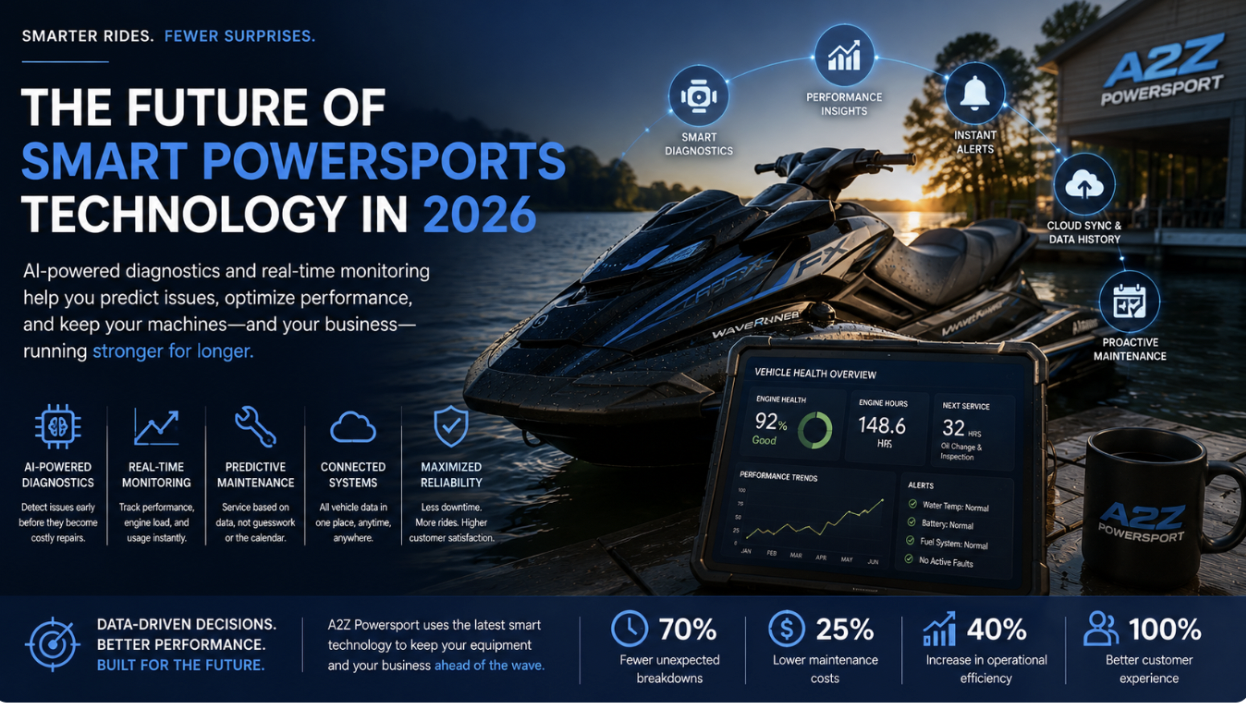
Smart powersports technology refers to the integration of onboard sensors, AI-driven diagnostics, and connected software systems into personal watercraft and powersports vehicles to enable real-time monitoring, predictive maintenance, and performance optimization. Rather than waiting for a warning light or a mechanical failure, these systems continuously collect and interpret vehicle data. Allowing operators to act on what the machine is telling them before anything goes wrong.
What Is Actually Breaking Down in Powersports Maintenance Right Now?
The real problem is not that powersports vehicles break down. It is that they break down without warning, and the information needed to prevent the failure was available the whole time. Just not captured.
Traditional maintenance in the powersports industry runs on two inputs: calendar intervals and rider-reported symptoms. Both are structurally unreliable. Calendar intervals assume consistent usage, which is almost never true in rental environments where a single Waverunner might sit idle for four days and then run eight hours in one afternoon. Rider-reported symptoms depend on the rider noticing something is wrong, which requires mechanical intuition most recreational users do not have and should not need.
The result is a maintenance gap. Not a maintenance failure. The technician is doing everything right by the schedule. The schedule just does not reflect what the machine actually experienced.
This is the specific root cause that smart diagnostics addresses: the disconnect between usage reality and maintenance timing.
Why Does the Old Approach Keep Failing Even When Operators Try to Fix It?
Because the fix most operators reach for, more frequent scheduled maintenance, does not solve the underlying problem. It just increases cost without increasing accuracy.
More frequent oil changes do not help if the actual failure mode is thermal stress from repeated high-load cycles. Replacing impellers on a fixed calendar does not account for the difference between a machine that ran calm bay water for 40 hours and one that ran choppy Gulf conditions for the same duration. The failure patterns are different. The maintenance response should be different too.
This is where AI-assisted performance monitoring changes the logic entirely. Instead of treating all hours as equivalent, these systems weight usage by intensity. Tracking throttle position, engine temperature, RPM variance, and load cycles simultaneously. The output is not just “hours logged.” It is a stress profile for that specific machine, on that specific day, under those specific conditions.
One commercial Waverunner fleet operator in the Gulf Coast region documented this pattern directly: after integrating telematics monitoring across a 12-unit fleet, they identified that three specific units were accumulating thermal stress at roughly twice the rate of the others. All three assigned to the same launch zone with shallower water and more frequent full-throttle starts. The calendar said all 12 units were due for the same service. The data said three needed attention now and nine could wait six more weeks. That is not a scheduling optimization. That is a different category of information entirely.
How Do Connected Maintenance Systems Actually Work. And What Do They Change?
A connected maintenance system is a software layer that aggregates sensor data from the vehicle, stores it in a cloud-accessible record, and surfaces actionable alerts to operators and service technicians based on pre-defined thresholds or AI-learned patterns.
The mechanism that makes this valuable is not the data collection itself. It is the continuity of the record. Traditional maintenance logs are technician-dependent. They capture what the technician observed and recorded, which is always a snapshot. Connected systems capture what the machine experienced continuously, which is a longitudinal record.
A vehicle with a connected maintenance history is fundamentally different from a vehicle without one. Not because it runs better today, but because every future diagnosis starts from a complete picture instead of a blank slate.
For rental operations like A2Z Powersport, where multiple staff members interact with the same equipment across different shifts and seasons, this continuity matters enormously. When a technician picks up a unit that has been running for a full summer season, a connected system tells them exactly what that machine has been through. A paper log tells them what someone remembered to write down.
The Proactive Servicing Advantage: What Changes When You Stop Reacting?
Proactive servicing is maintenance triggered by condition data rather than elapsed time or observed symptoms. The distinction sounds incremental. The operational outcome is not.
Consider a realistic scenario: a 10-unit personal watercraft rental fleet operating a full summer season in Orange Beach. Under reactive maintenance, fix it when it breaks, industry practitioners report that unplanned mechanical downtime typically removes a unit from service for two to four days per incident, factoring in parts availability and technician scheduling. In peak season, that is revenue-generating capacity sitting on a trailer.
Under a proactive model with connected diagnostics, the same fleet catches developing issues during off-peak hours, early morning, between rental windows, and schedules service before the unit fails mid-rental. The unit comes out of service for a planned two-hour window instead of an unplanned 48-hour repair cycle.
The financial case is straightforward. The operational case is more important: a customer whose rental gets cut short because of a mechanical failure does not just lose that hour on the water. They lose confidence in the operator. In a market like Orange Beach where repeat visitors and word-of-mouth referrals drive a significant portion of bookings, that trust cost is harder to recover than the repair bill.
A2Z Powersport’s commitment to premium, worry-free experiences is not just a service philosophy. It is a direct argument for the kind of operational reliability that smart maintenance systems make possible.
The Smart Powersports Technology Readiness Framework
Use this framework, called the RIDE Readiness Matrix, to assess whether a powersports operation is positioned to benefit from smart technology integration.
| Dimension | Not Ready | Ready | Optimized |
| R. Record Continuity | Paper logs, gaps common | Digital logs, manual entry | Automated sensor capture |
| I. Incident Pattern Visibility | Failures tracked ad hoc | Failures logged post-event | Failures predicted pre-event |
| D. Diagnostic Depth | Visual inspection only | OBD-style code reading | Multi-sensor AI analysis |
| E. Equipment Cycle Awareness | Calendar-based only | Hours-based | Usage-intensity weighted |
Use this when evaluating a fleet upgrade or vendor selection. Not when assessing a single recreational vehicle. The framework is designed for operators managing multiple units across high-cycle environments.
What Are the Real Limitations of Smart Powersports Technology?
This is not a universal solution. And saying so is more useful than pretending otherwise.
Smart diagnostics requires consistent connectivity infrastructure. Which is not always reliable in open-water environments. Offshore or remote riding conditions can create data gaps that undermine the continuity advantage these systems depend on. Operators in areas with poor cellular or marina Wi-Fi coverage will see reduced system performance.
The technology also has a learning curve for service staff. AI-generated maintenance alerts are only as useful as the technician’s ability to interpret and act on them. A system that flags a thermal anomaly is not helpful if the person reading the alert does not understand what it means or does not trust it enough to act before a visible symptom appears.
And for individual recreational riders. Someone who takes their personal watercraft out six times a year. The ROI case for full telematics integration is weak. This technology pays off in high-cycle, multi-unit environments. Single-unit recreational use does not generate enough data density for predictive models to function accurately.
A2Z Powersport’s approach to equipment care reflects this honestly: the value of smart servicing is in what it prevents, not just what it fixes.
What Does 2026 Actually Look Like for Powersports Technology?
The short answer: normalization. What is currently a competitive differentiator for forward-thinking fleet operators will become a baseline expectation.
Yamaha, Sea-Doo, and Kawasaki have all moved toward increased onboard diagnostics in their current-generation personal watercraft. The infrastructure for connected maintenance is already embedded in newer models. What 2026 brings is the software layer that makes that hardware useful at scale.
AI-assisted performance monitoring will shift from exception-based alerting (notify me when something is wrong) to continuous optimization (adjust service intervals dynamically based on accumulated stress data). The distinction matters because exception-based systems still require a threshold to be crossed before they act. Continuous optimization systems act before any threshold is approached.
The operators who treat smart technology as a maintenance tool are thinking too small. It is actually a customer experience tool. Because the rider who never experiences a mechanical interruption never has to think about the operator’s equipment reliability at all. That invisibility is the goal.
For guests booking water sports experiences through A2Z Powersport, this is exactly the kind of behind-the-scenes investment that makes the difference between a good day on the water and a story worth telling when they get home. Pairing reliable equipment with essential jet skiing safety practices for beginners ensures that every rider, whether first-timer or returning guest, has the experience they came for.
Frequently Asked Questions
What exactly is smart powersports technology and how is it different from regular diagnostics?
Smart powersports technology combines onboard sensors, AI analysis, and connected software to monitor vehicle performance continuously. Not just when a fault code appears. Regular diagnostics read existing error codes after something has already gone wrong. Smart systems identify stress patterns and usage anomalies before a failure occurs, giving operators time to act rather than react.
How does AI-assisted monitoring actually help someone renting out jet skis?
For a rental operator, AI monitoring means knowing which units in the fleet are accumulating stress faster than others based on how they are actually being used. Not just how many hours they have logged. That means maintenance resources go to the machines that need attention, not the ones that are due on a calendar, which reduces both downtime and unnecessary service costs.
Is this technology already available or is it still mostly theoretical for 2026?
The foundational hardware. Onboard sensors, telematics modules, Bluetooth and cellular connectivity. Already exists in current-generation personal watercraft from major manufacturers. What is developing rapidly heading into 2026 is the software layer: the AI models that interpret the data and the connected platforms that make it actionable for fleet operators without requiring a dedicated data analyst.
How long does it take for a fleet operator to see real results from smart diagnostics?
Practitioners report that meaningful pattern data typically emerges after four to six weeks of consistent operation across a multi-unit fleet. The first month establishes a baseline for each unit. By the second month, the system can begin flagging deviations from that baseline. Which is when proactive scheduling decisions become possible. Full predictive accuracy improves over a full season of data.
Does smart maintenance technology work for individual recreational riders or just commercial fleets?
It works best in high-cycle, multi-unit commercial environments where data density is high enough for AI models to identify meaningful patterns. Individual recreational riders who use their watercraft seasonally generate too few data points for predictive systems to function reliably. The cost-benefit case for individual use is weak; the case for rental fleets and commercial operators is strong.
What happens to the maintenance data if I switch equipment or change service providers?
Connected maintenance systems store data in cloud-based records tied to the vehicle’s identification, not the operator’s account in most implementations. This means the service history travels with the machine. A significant advantage when selling or transferring equipment, because the next operator inherits a complete performance record rather than starting blind. Data portability standards are still evolving across manufacturers.
How does smart technology affect the experience for someone just renting a jet ski for an afternoon?
The rider does not interact with the technology directly. What they experience is the outcome of it: equipment that has been serviced based on actual condition rather than guesswork, which means fewer mechanical interruptions, more consistent performance, and a rental operation that can confidently put them on the water without worrying about what might happen mid-ride. The technology is invisible. The reliability is not.
Ready to experience what advanced powersports care actually feels like from the rider’s side? Contact A2Z Powersport to learn more about our approach to equipment, safety, and water experiences built around reliability. Not just availability. Reach us at 26619 Perdido Beach Blvd, Orange Beach, AL 36561, or call (954) 296-1862.
References
Yamaha Motor Corporation. Manufacturer documentation on current-generation WaveRunner onboard diagnostics and connectivity features
Sea-Doo (BRP). Product engineering resources covering intelligent throttle and diagnostic systems in personal watercraft
Kawasaki Motors. Technical resources on Jet Ski diagnostic architecture and service interval frameworks
McKinsey & Company. Research on predictive maintenance economics in asset-intensive industries, covering ROI frameworks applicable to fleet operations
Gartner. Research on AI integration in operational technology and the shift from reactive to predictive maintenance models across industrial equipment categories